




Key Takeaways
- L‑theanine is an amino acid found almost exclusively in tea leaves (Camellia sinensis) that crosses the blood–brain barrier and promotes relaxation without sedation.
- Clinical trials consistently use doses of 200–400 mg per day. At these levels, L‑theanine has been shown to reduce subjective stress, lower cortisol responses to acute stressors, and improve aspects of sleep quality.
- The evidence for anxiety and stress reduction is moderate but consistent across multiple RCTs and systematic reviews. Effects on sleep are more modest and may be strongest in people whose sleep issues are stress‑related.
- L‑theanine has an excellent safety profile. No serious adverse events have been reported at studied doses, and it does not cause drowsiness or dependence.
- Most research is in healthy or moderately stressed adults. Data in diagnosed anxiety disorders remain limited, though a 2024 systematic review found preliminary benefits.
What Is L‑Theanine?
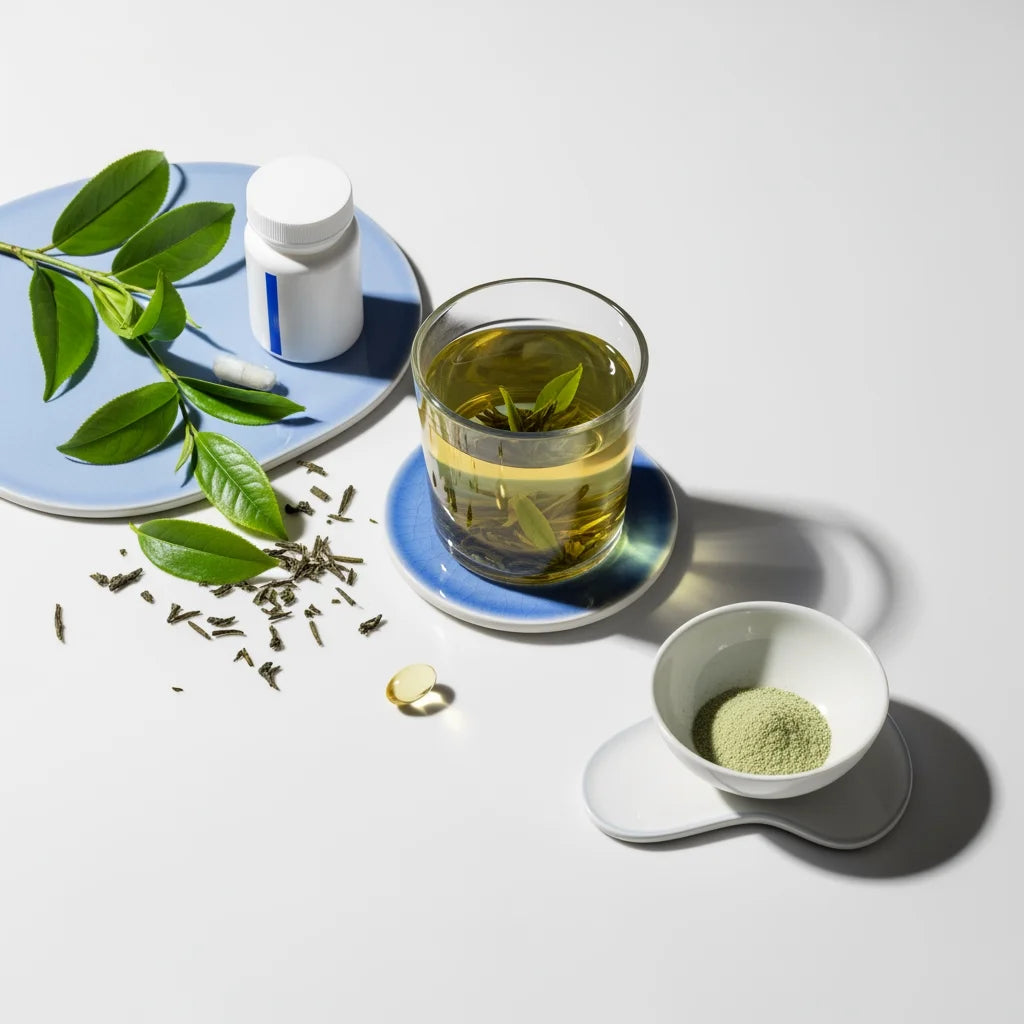
L‑theanine (γ‑glutamylethylamide) is a non‑protein amino acid found primarily in the leaves of Camellia sinensis — the plant behind green, black, and white tea. Structurally, it resembles the neurotransmitter glutamate, which turns out to be central to how it works.
First isolated from gyokuro green tea in 1949 by Japanese researchers, L‑theanine accounts for roughly 1–2% of the dry weight of tea leaves and is responsible for the savory, brothy flavor known as umami. A typical cup of green tea contains about 8–30 mg of L‑theanine, depending on the variety, growing conditions, and brewing method. Supplement doses (200–400 mg) are therefore substantially higher than what one would get from tea alone.
Unlike many botanical compounds, L‑theanine has been relatively well‑studied in human trials, with a mechanistic picture that is clearer than most. And unlike GABA supplements — which do not efficiently cross the blood–brain barrier — L‑theanine reliably reaches the central nervous system via the neutral amino acid (leucine) transport system (Chen et al., 2024).
What the Research Shows
Mechanism of Action: Why "Calm but Alert" Isn't Just Marketing
The neurochemical basis of L‑theanine's effects is unusually well‑characterized for a dietary supplement. It operates through at least four pathways:
- Glutamate receptor modulation. L‑theanine acts as a partial co‑agonist at the glycine site of the NMDA receptor — meaning it modulates excitatory signaling rather than simply blocking it (Chen et al., 2024). At AMPA and kainate receptors, its affinity is very low (80–30,000× weaker than glutamate), so its primary glutamatergic effect is through NMDA modulation and reduced presynaptic glutamate release.
- Increased GABA levels. Multiple studies report that L‑theanine raises brain concentrations of gamma‑aminobutyric acid (GABA), the primary inhibitory neurotransmitter. It also upregulates GABAA receptor expression in animal models (Chen et al., 2022).
- Alpha‑wave promotion. EEG studies consistently show that L‑theanine increases alpha‑band (8–14 Hz) brain activity, a pattern associated with relaxed alertness. A 2021 randomized, triple‑blind crossover trial found that a single 200 mg dose increased both frontal and whole‑scalp alpha power at 3 hours post‑ingestion compared to placebo (Evans et al., 2021).
- Neurotransmitter balance. L‑theanine also modulates serotonin and dopamine levels, though these effects appear secondary to its glutamate/GABA activity and are less well‑quantified in humans.
The net effect is a shift toward inhibitory tone without sedation — a profile that distinguishes L‑theanine from compounds like benzodiazepines (which produce sedation, tolerance, and dependence) or alcohol (which impairs cognition).
Stress and Anxiety: The Core Evidence
The most consistent finding across L‑theanine research is its effect on stress responses. A 2020 systematic review of 9 RCTs concluded that 200–400 mg/day of L‑theanine "may help reduce stress and anxiety in people exposed to stressful conditions" (Williams et al., 2020).
The strongest single‑study evidence comes from a 2021 randomized, triple‑blind, placebo‑controlled crossover trial using AlphaWave L‑theanine (200 mg) in moderately stressed adults (Evans et al., 2021). Key findings:
- Reduced salivary cortisol: Participants showed a blunted cortisol response during an acute mental arithmetic stressor compared to placebo.
- Improved subjective anxiety: State anxiety scores on validated scales improved relative to placebo.
- EEG changes: Increased frontal and whole‑scalp alpha power, consistent with a relaxation response, were observed 3 hours post‑dose.
A separate 4‑week RCT with 200 mg/day L‑theanine in healthy adults found significant reductions in trait anxiety (STAI‑T) and depressive symptoms (SDS) compared to placebo (Hidese et al., 2019).
A 2024 systematic review published in BMC Psychiatry examined L‑theanine across 11 RCTs in patients with diagnosed mental disorders — including generalized anxiety disorder, sleep disorders, major depressive disorder, schizophrenia, and ADHD. The authors reported that L‑theanine "significantly reduced psychiatric symptoms more effectively than control conditions in individuals with schizophrenia, anxiety disorders, and ADHD," though they emphasized the need for larger trials (Monsef & Aalaei, 2024).
It's worth noting what the evidence does not show: L‑theanine has not been demonstrated to be effective as a monotherapy for diagnosed generalized anxiety disorder, panic disorder, or major depression. The data are strongest for ameliorating stress responses in otherwise healthy individuals who are under acute or ongoing stress.
Sleep Quality: Modest but Real
The evidence for L‑theanine and sleep is less consistent than for stress, but several trials suggest benefit — particularly in people whose sleep disruption is stress‑related.
A 2025 systematic review of 13 trials (n = 550) examining L‑theanine as a standalone intervention for sleep concluded that doses of 200–450 mg/day "appear to be a safe and effective way to support healthy sleep in adults" (Kim et al., 2025). Beneficial effects were reported on sleep latency, sleep efficiency, and subjective sleep satisfaction.
The 2019 Hidese trial found that 200 mg/day L‑theanine over 4 weeks improved global PSQI scores, with specific benefits on sleep latency, sleep disturbance, and reduced use of sleep medication (Hidese et al., 2019). A 2024 RCT using a higher dose (400 mg/day AlphaWave L‑theanine) found decreased light sleep and improved subjective sleep quality over 28 days in moderately stressed adults (Evans et al., 2024).
Importantly, L‑theanine does not appear to act as a sedative — it doesn't force sleep onset the way antihistamines or benzodiazepine receptor agonists do. Instead, its sleep benefits likely arise from reducing the hyperarousal that interferes with natural sleep onset and maintenance. This makes it better suited for stress‑related sleep disruption than for primary insomnia of non‑stress origin.
Dosing and Practical Considerations
What Doses Were Studied?
Across the clinical literature, three dosing patterns predominate:
- Acute stress (single dose): 200 mg, taken approximately 1 hour before an anticipated stressor. The Evans et al. (2021) trial found that this protocol produced measurable EEG changes and cortisol reduction within 1–3 hours.
- Chronic daily dosing: 200–400 mg/day, divided once or twice daily, for 4–8 weeks. Most trials showing sustained improvements in anxiety, mood, and sleep used this approach.
- Sleep‑specific dosing: 200–450 mg, taken 30–60 minutes before bedtime. No evidence of next‑day grogginess has been reported at these doses.
There is no established upper limit for L‑theanine, but trials have not systematically studied doses above 900 mg/day. The available data suggest diminishing returns above 400 mg/day for stress and sleep outcomes, though this has not been formally tested in dose‑response studies.
Bioavailability and Timing
L‑theanine is well‑absorbed from the small intestine and reaches peak plasma concentration within approximately 30–60 minutes after oral administration. Taking it with food does not meaningfully impair absorption. Some evidence suggests that taking L‑theanine on an empty stomach results in slightly faster absorption, but the difference is unlikely to be clinically significant.
For stress reduction, taking L‑theanine 30–60 minutes before a known stressor appears optimal based on pharmacokinetic data. For general anxiety or sleep support, consistent daily dosing is more important than precise timing.
Synergy with Caffeine
One of the more interesting findings in the L‑theanine literature is its interaction with caffeine. When combined, L‑theanine appears to attenuate some of caffeine's less desirable effects — jitteriness, blood pressure elevation — while preserving (and in some studies, enhancing) its cognitive benefits. A 2025 systematic review and meta‑analysis found that L‑theanine plus caffeine produced small‑to‑moderate improvements in attention and reaction time compared to placebo, with effects most pronounced in the first 1–2 hours post‑intake (Dodd et al., 2025).
The common ratio used in studies is 2:1 (e.g., 200 mg L‑theanine with 100 mg caffeine), which roughly mirrors the ratio found in some green tea varieties. This synergy likely contributes to the distinctive "calm focus" that tea drinkers report compared to the sharper, sometimes jittery stimulation of coffee.
Safety and Interactions
L‑theanine has an excellent safety profile in the clinical literature. Across all RCTs reviewed, no serious adverse events have been attributed to L‑theanine at doses up to 900 mg/day. Mild, transient side effects — headache, dizziness, gastrointestinal discomfort — have been reported at rates comparable to placebo.
Key safety points:
- No dependence or withdrawal: Unlike benzodiazepines or GABAergic sedatives, L‑theanine does not produce tolerance, dependence, or withdrawal symptoms upon discontinuation.
- No sedation: L‑theanine is not a CNS depressant. It does not impair driving or psychomotor performance. This distinguishes it from many sleep aids and anxiolytics.
- Drug interactions: Theoretical interactions exist with medications that affect GABA or glutamate signaling (e.g., benzodiazepines, barbiturates, anticonvulsants) and with antihypertensives, since L‑theanine may modestly lower blood pressure under acute stress. However, no clinically significant interactions have been reported in trials. Anyone taking such medications should consult their prescribing physician.
- Pregnancy and lactation: No human safety data exist for L‑theanine supplementation during pregnancy or breastfeeding. Given the absence of data, supplementation is generally not recommended during these periods. Dietary intake from tea is presumed safe but should be discussed with a healthcare provider.
Bottom Line
L‑theanine is one of the better‑studied dietary supplements for stress management, with a plausible mechanism of action, consistent (if modest) effects across multiple RCTs, and an excellent safety profile. The evidence is strongest for reducing stress responses in healthy adults facing acute or ongoing stressors. Effects on sleep quality are present but more modest, and likely mediated by stress reduction rather than direct sedative action.
For most people, 200 mg taken before a stressor or 200–400 mg/day for ongoing support represents an evidence‑based approach with minimal downside risk. It is not a substitute for treatment of diagnosed anxiety disorders, and expectations should be calibrated accordingly. This is a compound that helps the brain shift from a stress‑dominant state to a more relaxed one — not one that overrides the stress response entirely.
Frequently Asked Questions
How quickly does L‑theanine work?
For acute stress reduction, effects are detectable within 30–60 minutes of ingestion, with peak effects around 1–3 hours post‑dose. For sustained improvements in mood, anxiety, or sleep, most trials used at least 4 weeks of daily dosing to observe meaningful changes.
Does L‑theanine make you sleepy?
No. L‑theanine promotes relaxation without sedation. EEG studies consistently show it increases alpha‑wave activity (associated with calm alertness), not theta or delta activity (associated with drowsiness or sleep). It may help you fall asleep if stress or racing thoughts are keeping you awake, but it won't make you sleepy during the day.
Can you take L‑theanine every day?
Yes. Multiple trials have used daily dosing for 4–8 weeks without adverse effects or evidence of tolerance. There is no indication that L‑theanine loses effectiveness with continued use.
Is L‑theanine from supplements different from L‑theanine in tea?
Chemically, no — it is the same compound. The difference is in dose: a cup of green tea typically provides 8–30 mg of L‑theanine, while supplement doses used in research are 200–400 mg. The supplement form is also free of caffeine (unless combined intentionally), whereas tea always contains some caffeine.
Does L‑theanine interact with any medications?
No clinically significant interactions have been reported in trials. However, because L‑theanine affects neurotransmitter systems, theoretical interactions exist with medications that target GABA, glutamate, or blood pressure regulation. Consult a healthcare provider if you take prescription medications, particularly for anxiety, sleep, seizures, or hypertension.
Ready to put the science into practice?
Evoria's Night Recovery supports deep rest and overnight renewal so you wake up refreshed and ready to perform. Shop Night Recovery →
References
- Williams J, et al. "The Effects of Green Tea Amino Acid L‑Theanine Consumption on the Ability to Manage Stress and Anxiety Levels: a Systematic Review." Plant Foods for Human Nutrition, 2020.
- Evans M, et al. "The Effects of AlphaWave L‑Theanine on Stress Reactivity and Cortisol Levels in Moderately Stressed Adults." Neurology and Therapy, 2021.
- Hidese S, et al. "Effects of L‑Theanine Administration on Stress‑Related Symptoms and Cognitive Functions in Healthy Adults: A Randomized Controlled Trial." Nutrients, 2019.
- Monsef S, Aalaei S. "The Effects of L‑Theanine Supplementation on the Outcomes of Patients with Mental Disorders: A Systematic Review." BMC Psychiatry, 2024.
- Chen Y, et al. "L‑Theanine: A Comprehensive Review of Its Pharmacology and Health Benefits." Pharmacological Research, 2024.
- Chen Z, et al. "L‑Theanine and Its Derivatives: Mechanisms of Neuroprotection and Anti‑Stress Effects." Frontiers in Nutrition, 2022.
- Evans M, et al. "Safety and Efficacy of AlphaWave L‑Theanine Supplementation for 28 Days in Healthy Adults with Moderate Stress." Neurology and Therapy, 2024.
- Kim S, et al. "Examining the Effect of L‑Theanine on Sleep: A Systematic Review of Clinical Studies." Sleep Medicine Reviews, 2025.
- Dodd FL, et al. "Effects of Tea or Its Bioactive Compounds L‑Theanine or L‑Theanine plus Caffeine on Cognition, Sleep, and Mood in Healthy Participants: A Systematic Review and Meta‑Analysis." Nutrition Reviews, 2025.
*These statements have not been evaluated by the Food and Drug Administration. This product is not intended to diagnose, treat, cure, or prevent any disease.
Share:
Why Am I Still Tired After 8 Hours of Sleep?
Nutrition Timing: Does When You Take Supplements Actually Matter?