




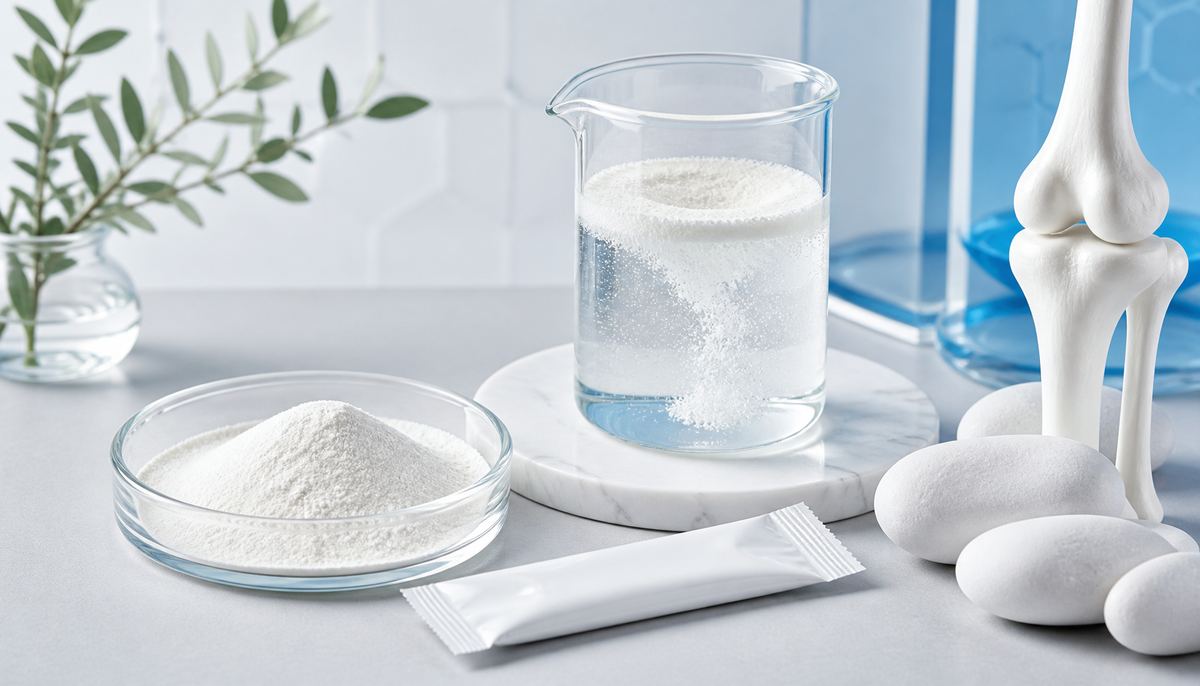
Here is the uncomfortable fact at the center of the collagen market: when you swallow collagen, your body does not ship it intact to your face, knees, or bones. It digests it, like any other protein. For years, that single observation led many researchers to dismiss collagen supplements as expensive gelatin. And yet dozens of randomized controlled trials now report measurable changes in skin elasticity, joint comfort, and bone density markers.
Both things can be true. Collagen is broken down, but not completely — and some of the fragments that survive digestion appear to be biologically active. The more interesting question is not "does collagen work?" but "for which outcome, at what dose, and how much should we trust the studies?" As we'll see, the answer differs quite a bit for skin, joints, and bone, and one recent meta-analysis has raised a pointed question about who funds the research.
🔑 Key Takeaways
- Hydrolyzed collagen (collagen peptides) is digested, but di- and tripeptides containing hydroxyproline reach the bloodstream and may act as signaling molecules for collagen-producing cells
- Skin: pooled trials suggest improvements in hydration and elasticity, but a 2025 meta-analysis found the effect disappeared in independently funded and high-quality studies — the evidence is real but contested
- Joints: this is the most robust area, with a 2024 meta-analysis of 35 RCTs reporting small-to-moderate improvements in joint pain and function scores
- Bone: promising but thin — largely one well-designed 12-month RCT in postmenopausal women plus an open-label follow-up
- Collagen is well tolerated in trials; the main considerations are source allergies (fish, bovine, porcine) and the fact that it is an incomplete protein
What Are Collagen Peptides?
Collagen is the most abundant protein in the human body, forming the structural scaffolding of skin, tendons, ligaments, cartilage, and bone. It has an unusual amino acid profile: roughly one-third glycine, with high concentrations of proline and hydroxyproline — an amino acid found almost nowhere else in the diet. Our own collagen production declines gradually from early adulthood, which is the biological rationale behind supplementation.
Supplements typically use hydrolyzed collagen (also called collagen peptides or collagen hydrolysate): collagen from bovine hide, porcine skin, or fish skin and scales that has been enzymatically broken into short chains, usually averaging 2,000–5,000 daltons. Hydrolysis makes the powder dissolve in cold water and, importantly, produces the small peptides believed to drive the effects seen in trials. This is distinct from undenatured type II collagen (often sold as UC-II), which is taken in milligram doses and is thought to work through an entirely different, immune-mediated mechanism. The two are frequently lumped together in reviews, which muddies the evidence — a point we'll return to.
Does Collagen Survive Digestion?
Partly. Most ingested collagen is broken down to free amino acids, but collagen's proline- and hydroxyproline-rich sequences resist complete digestion. A 2024 randomized, double-blind crossover study (Virgilio et al., 2024) measured blood levels after volunteers took collagen hydrolysates from fish, porcine, and bovine sources. All sources produced comparable uptake, and total hydroxyproline in plasma substantially exceeded free hydroxyproline — meaning meaningful amounts circulated as intact di- and tripeptides such as prolyl-hydroxyproline (Pro-Hyp).
Cell and animal studies suggest these peptides may stimulate fibroblasts (skin), chondrocytes (cartilage), and osteoblasts (bone) to increase their own collagen and matrix production. The human link between "peptide in blood" and "tissue outcome" is still being mapped, and the authors themselves note that larger studies are needed to define what circulating levels matter. Notably, this study was conducted by employees of a collagen manufacturer — a theme that recurs throughout this literature.
What the Research Shows
Skin: Hydration, Elasticity, and Wrinkles
Skin is the most-studied and most-marketed application. A 2021 meta-analysis of 19 randomized, double-blind trials involving 1,125 participants (95% women, aged 20–70) found that hydrolyzed collagen improved skin hydration, elasticity, and wrinkle measures compared with placebo, with most trials lasting around 90 days (de Miranda et al., 2021). A larger 2023 meta-analysis of 26 RCTs and 1,721 participants reached a similar conclusion for hydration and elasticity, while flagging several sources of bias in the included trials and calling for larger, independent studies (Pu et al., 2023).
Then came a sharper lens. A 2025 meta-analysis in the American Journal of Medicine pooled 23 RCTs (1,474 participants) and, like the earlier reviews, found an overall benefit. But when the authors split trials by funding source, the picture changed: studies funded by industry showed significant improvements, while studies without industry funding showed no effect on hydration, elasticity, or wrinkles. High-quality trials likewise showed no significant effect (Myung & Park, 2025).
How should you read that? It doesn't prove collagen is ineffective — industry-funded trials are not automatically wrong, and the independent subgroup was smaller and therefore less statistically powered. But it does mean the skin evidence is weaker than the marketing implies. An honest summary: a consistent signal, from a literature with a meaningful risk of funding and quality bias.
Joints: The Strongest Case
The joint data are more convincing, partly because they've been subjected to more rigorous statistical scrutiny. A 2024 trial sequential meta-analysis in Osteoarthritis and Cartilage included 35 RCTs with 3,165 participants and found small-to-moderate improvements in pain (standardized mean difference −0.35) and function (SMD −0.31), rated as moderate- and high-certainty evidence respectively. Collagen derivatives did not increase adverse events or dropouts versus control, and the trial sequential analysis suggested the evidence base is large enough that further trials are unlikely to overturn the finding (Liang et al., 2024).
An updated 2024 meta-analysis focused on the knee — 11 RCTs, 870 participants — similarly reported improvements in both function and pain scores favoring collagen, though with high heterogeneity between studies (Simental-Mendía et al., 2024). One important caveat: both reviews combined hydrolyzed collagen peptides with undenatured type II collagen. These are different products with different doses and proposed mechanisms, so the pooled numbers don't map cleanly onto any single supplement.
Joint research isn't limited to older adults. In a 12-week RCT, 180 physically active adults aged 18–30 with activity-related knee discomfort (but no diagnosed joint condition) took 5 g of specific collagen peptides or placebo daily. The collagen group reported a significantly greater reduction in exercise-related knee discomfort (−21.9 mm vs. −15.6 mm on a 100 mm visual analog scale), a finding mirrored by the examining physician's assessment (Zdzieblik et al., 2021). Notice the placebo group improved substantially too — a reminder of how large placebo effects are in pain research, and why controlled trials matter.
Bone: Promising but Thin
Bone is where the evidence is most preliminary. The anchor study is a 12-month, double-blind RCT in 131 postmenopausal women with age-related reductions in bone mineral density (BMD). Women taking 5 g of specific collagen peptides daily saw small increases in spine and femoral neck BMD, while the placebo group declined slightly. Bone formation markers (P1NP) rose in the collagen group, while a bone breakdown marker (CTX-1) rose in the placebo group (König et al., 2018).
An open-label follow-up of 31 of those women over a total of four years reported continued BMD increases in the spine (Zdzieblik et al., 2021). That's encouraging, but an uncontrolled follow-up of a small subgroup can't establish cause and effect. Until independent groups replicate these results, bone support remains the least-established of collagen's three main applications.
Dosing & Practical Considerations
- Studied doses vary by goal. Skin trials have generally used roughly 2.5–10 g/day of hydrolyzed collagen; the joint and bone trials described above used 5 g/day of specific peptides, while many osteoarthritis trials used around 10 g/day. Undenatured type II collagen is a separate category studied at about 40 mg/day.
- Peptide specifics matter. Many positive trials used proprietary peptide formulations with particular molecular-weight profiles. Results from one formulation don't automatically transfer to another, even at the same gram dose.
- Source is mostly a preference. Bioavailability data suggest fish, bovine, and porcine hydrolysates deliver comparable circulating peptides (Virgilio et al., 2024). Choose based on dietary preferences, allergies, and sourcing transparency.
- Give it time. Most skin trials run 8–12 weeks; joint trials 12–24 weeks; bone trials 12 months. Collagen turnover is slow, and short trials are unlikely to show much.
- Timing is flexible. There's no strong evidence for an optimal time of day. One small study found that taking gelatin with vitamin C about an hour before brief exercise increased a marker of collagen synthesis (Shaw et al., 2017), but this hasn't translated into firm recommendations. Consistency likely matters more than timing.
- Vitamin C is a cofactor. Your body needs vitamin C to build collagen. Most people eating fruits and vegetables get enough, but it's worth not neglecting.
Safety & Interactions
Collagen peptides have a strong safety record in trials. The 2024 osteoarthritis meta-analysis found no increase in adverse events or withdrawals compared with control (Liang et al., 2024). The most common complaints are mild — a feeling of fullness, an aftertaste, or occasional digestive discomfort.
- Allergies: Marine collagen is derived from fish; people with fish allergies should avoid it. Bovine and porcine sources may conflict with dietary or religious practices.
- Incomplete protein: Collagen lacks tryptophan and is low in several essential amino acids. It shouldn't be counted as a full replacement for other dietary protein.
- Kidney stone history: Hydroxyproline is metabolized partly to oxalate. The practical relevance at typical doses is unclear, but people with a history of calcium oxalate stones may want to discuss collagen with a clinician.
- Quality control: Because collagen is sourced from animal tissue, look for third-party testing for heavy metals and contaminants.
- Pregnancy and breastfeeding: Specific safety data are limited; consult a healthcare provider.
Bottom Line
Collagen peptides are not the expensive gelatin skeptics once assumed — bioactive fragments do reach circulation, and the joint evidence in particular is reasonably strong, with a large meta-analysis showing small-to-moderate benefits. The skin data are consistent but undermined by funding and quality concerns, and the bone data rest largely on a single research group. If you try collagen, expect modest, gradual effects over months rather than weeks.
Frequently Asked Questions
Does collagen actually get absorbed, or is it just digested?
Both. Most collagen is digested into amino acids, but human studies show that hydroxyproline-containing di- and tripeptides such as Pro-Hyp reach the bloodstream intact. Laboratory research suggests these peptides may signal cells to produce more collagen, though the link to tissue outcomes in humans is still being studied.
How long does collagen take to work?
Most skin trials measured outcomes after 8–12 weeks, joint trials after 12–24 weeks, and the main bone trial after 12 months. Collagen-rich tissues turn over slowly, so changes, if any, tend to be gradual.
Is marine collagen better than bovine collagen?
Not clearly. A 2024 crossover study found comparable absorption of collagen peptides from fish, porcine, and bovine sources. Choosing between them is mostly a matter of allergies, dietary preferences, and sourcing quality.
How much collagen should I take?
Trials have generally used about 2.5–10 g per day of hydrolyzed collagen, depending on the outcome studied. Many positive trials used specific proprietary peptide formulations, so results may not apply equally to every product.
Are collagen supplements safe?
Trials report a good safety profile with no increase in adverse events versus placebo. People with fish allergies should avoid marine collagen, and anyone with a history of kidney stones, or who is pregnant or breastfeeding, should consult a healthcare provider first.
Ready to put the science into practice?
Evoria's Collagen Renewal pairs 10 g of marine collagen peptides with 250 mg of NMN in one daily stick pack, formulated to support skin, hair, nails, joints, and healthy aging as part of a consistent routine. Shop Collagen Renewal →
References
- Virgilio N, Schön C, Mödinger Y, et al. Absorption of bioactive peptides following collagen hydrolysate intake: a randomized, double-blind crossover study in healthy individuals. Front Nutr. 2024;11:1416643. PubMed
- de Miranda RB, Weimer P, Rossi RC. Effects of hydrolyzed collagen supplementation on skin aging: a systematic review and meta-analysis. Int J Dermatol. 2021;60(12):1449-1461. PubMed
- Pu SY, Huang YL, Pu CM, et al. Effects of Oral Collagen for Skin Anti-Aging: A Systematic Review and Meta-Analysis. Nutrients. 2023;15(9):2080. PubMed
- Myung SK, Park Y. Effects of Collagen Supplements on Skin Aging: A Systematic Review and Meta-Analysis of Randomized Controlled Trials. Am J Med. 2025;138(9):1264-1277. PubMed
- Liang CW, Cheng HY, Lee YH, et al. Efficacy and safety of collagen derivatives for osteoarthritis: A trial sequential meta-analysis. Osteoarthritis Cartilage. 2024;32(5):574-584. PubMed
- Simental-Mendía M, Ortega-Mata D, Acosta-Olivo CA, et al. Effect of collagen supplementation on knee osteoarthritis: an updated systematic review and meta-analysis of randomised controlled trials. Clin Exp Rheumatol. 2025;43(1):126-134. PubMed
- Zdzieblik D, Brame J, Oesser S, et al. The Influence of Specific Bioactive Collagen Peptides on Knee Joint Discomfort in Young Physically Active Adults: A Randomized Controlled Trial. Nutrients. 2021;13(2):523. PubMed
- König D, Oesser S, Scharla S, et al. Specific Collagen Peptides Improve Bone Mineral Density and Bone Markers in Postmenopausal Women—A Randomized Controlled Study. Nutrients. 2018;10(1):97. PubMed
- Zdzieblik D, Oesser S, König D. Specific Bioactive Collagen Peptides in Osteopenia and Osteoporosis: Long-Term Observation in Postmenopausal Women. J Bone Metab. 2021;28(3):207-213. PubMed
- Shaw G, Lee-Barthel A, Ross ML, et al. Vitamin C-enriched gelatin supplementation before intermittent activity augments collagen synthesis. Am J Clin Nutr. 2017;105(1):136-143. PubMed
These statements have not been evaluated by the FDA. This product is not intended to diagnose, treat, cure, or prevent any disease.
Share:
How to Build a Wind-Down Routine That Actually Sticks
The Case for Boring Wellness: Why Simple Beats Extreme