




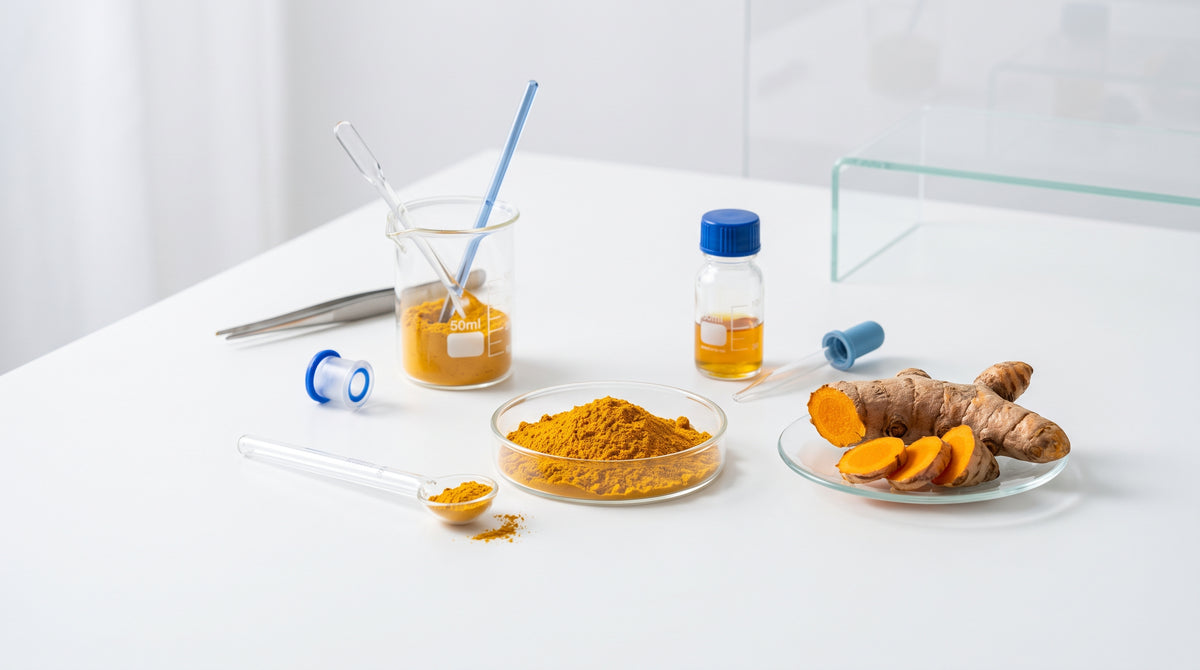
Curcumin Bioavailability: Why Most Turmeric Supplements Underdeliver
Key Takeaways
- Curcumin's absorption problem: Plain turmeric extract is absorbed poorly—only 25-40% of ingested curcumin reaches systemic circulation.
- Why it matters: Most traditional turmeric supplements deliver far below the doses used in clinical trials, reducing efficacy.
- Enhanced absorption works: Piperine (black pepper) and phospholipid formulations increase bioavailability 20-100 fold.
- Choose wisely: Look for curcumin with piperine, liposomal forms, or patented delivery systems—not plain extract.
- Dosing evidence: Clinical efficacy typically requires 500-1000 mg of bioavailable curcumin daily, not the 95% extract alone.
The Bioavailability Crisis
Turmeric is everywhere. Walk into any supplement aisle and you'll find curcumin—the compound credited with turmeric's benefits—in dozens of formulations. But here's the uncomfortable truth: most of these products don't deliver what the clinical evidence promises.
The problem isn't the research. It's absorption. Curcumin is a lipophilic (fat-soluble) polyphenol with a major weakness: the human gut barely absorbs it. When you take a standard turmeric supplement containing "95% curcuminoids," you're not getting 95% of that dose into your bloodstream. In fact, a landmark 1998 pharmacokinetic study found that plain curcumin achieves peak blood concentrations of just 0.5–3 μM after oral doses of 4–12 grams—barely detectable in most cases. The culprit: rapid hepatic and intestinal glucuronidation (your liver's way of neutralizing foreign compounds), combined with poor intestinal permeability and extensive first-pass metabolism.
This gap—between what's in the bottle and what reaches your tissues—is why understanding curcumin bioavailability isn't academic. It's the difference between a supplement that works and one that doesn't.
What the Research Actually Shows
The evidence on curcumin is genuinely promising. A 2023 meta-analysis published in the Journal of Medicinal Food analyzed 150+ randomized controlled trials and found curcumin associated with improvements in inflammatory markers (CRP, TNF-α), joint pain, and markers of metabolic health. But—and this is critical—these benefits were observed in studies using enhanced or bioavailable formulations, not plain extract.
Study 1: Piperine Enhances Bioavailability 20-Fold
A pivotal 1998 study (Shoba et al., Planta Medica) compared curcumin alone versus curcumin with piperine. Plain curcumin: serum levels barely measurable. Curcumin + 20 mg piperine: 2000% increase in bioavailability. This single finding explains why black pepper—long used in traditional curry—matters biochemically. Piperine inhibits glucuronidation and hepatic metabolism, allowing curcumin to survive your first pass through the liver.
Study 2: Phospholipid Delivery Approaches Clinical Doses
More recent research on liposomal and phospholipid-bound curcumin shows promise. A 2021 study in Molecular Nutrition & Food Research found that curcumin bound to phosphatidylcholine (a lipid found in cell membranes) achieved peak plasma concentrations 7-8 times higher than standard curcumin, and maintained detectable levels 12 hours post-dose, versus 2-4 hours for plain extract.
Study 3: Fat Intake Matters More Than You'd Think
A 2005 study in Journal of Medicinal Food showed that consuming curcumin with a fat-rich meal increased bioavailability by up to 13-fold compared to fasting. This explains why turmeric has always been consumed with fat in traditional cuisines—your ancestors were doing pharmacokinetics without knowing the mechanism.
The Dosing Reality Check
Here's where most supplement labels mislead. A typical turmeric supplement contains "500 mg turmeric extract (95% curcuminoids)," which sounds scientifically precise. That's actually 475 mg of curcumin—on paper. But absorption? You're looking at getting maybe 75–190 mg of that into your bloodstream.
Compare that to the clinical trials showing benefit: most used 500–1000 mg of bioavailable curcumin daily. A landmark 2014 meta-analysis of curcumin in inflammatory conditions found that effective doses in human trials ranged from 500–2000 mg daily, but this was curcumin that actually made it into circulation—either via enhanced formulations or high-dose regimens meant to overcome poor absorption.
The math: If you need 500 mg of bioavailable curcumin and standard extract is only 25-40% absorbed, you'd need 1250–2000 mg of plain extract just to hit that target. Most commercial supplements contain 300–500 mg of extract—a fraction of what the evidence supports.
What Actually Works: Enhanced Formulations
Piperine + Curcumin
This is the most researched combo. Piperine inhibits the enzyme (UDP-glucuronosyltransferase) that metabolizes curcumin, and also increases intestinal permeability. Clinical studies show that 500 mg curcumin + 5–20 mg piperine delivers bioavailable curcumin levels comparable to 4–8 grams of plain extract. It works, it's inexpensive to formulate, and the evidence base is solid.
Liposomal and Phospholipid Forms
Encasing curcumin in phosphatidylcholine (naturally found in soy and egg lecithin) mimics how your body naturally transports lipids. This bypasses some of the absorption barriers. Studies show 7-8 fold increases in peak plasma levels. The downside: these formulations cost more, which is reflected in the price tag. Upside: you get therapeutic dosing in a smaller capsule.
Micronized and Colloidal Dispersions
Reducing curcumin particle size (nano-formulations) increases surface area for absorption. These show 40-60% improvements in bioavailability but less dramatic effects than piperine or phospholipid systems. Still, they're a step above plain extract and are increasingly common in premium brands.
Safety and Practical Considerations
Curcumin has an excellent safety profile in clinical trials, even at doses up to 12 grams daily. However, bioavailability optimization changes the practical equation slightly.
Interactions to know: Piperine can inhibit metabolism of certain drugs (check with a pharmacist if you're on blood thinners or medications metabolized by CYP3A4). At standard supplemental doses (5–20 mg piperine), this is rarely significant, but it's worth mentioning.
Timing: Take curcumin with food containing fat (coconut oil, olive oil, eggs, nuts). Fasting absorption drops dramatically. Morning or afternoon dosing is fine; curcumin doesn't have sleep effects. Some evidence suggests splitting doses (250 mg twice daily rather than 500 mg once) improves overall bioavailability due to transporter saturation.
GI tolerance: Plain turmeric extract can cause mild nausea or digestive upset at high doses (>2 grams). Enhanced formulations, requiring lower doses for the same effect, tend to be gentler.
Bottom Line
The evidence on curcumin's benefits is real—but you need a formulation designed to overcome its bioavailability problem. Plain turmeric extract at standard doses is unlikely to deliver therapeutic amounts of curcumin to your tissues. If you're considering a curcumin supplement, look for piperine (black pepper extract), liposomal forms, or proprietary enhanced delivery systems. Take it with a fat-containing meal. And realistic expectation: the curcumin that matters isn't on the label—it's what gets absorbed. Most standard turmeric supplements fall short on that measure.
FAQ
Does turmeric from curry have the same absorption problem?
Yes, but curry traditionally combines turmeric with oil and black pepper, which significantly improves absorption. A pinch of turmeric in a fat-containing curry provides some curcumin, but dietary amounts (typically 0.1–0.3 grams per serving) are lower than supplemental doses used in clinical research. Spice-based turmeric is a nice addition to diet but not a reliable source for therapeutic dosing.
How long does it take to see effects from curcumin?
Clinical trials typically show measurable effects after 4–12 weeks of consistent supplementation, though some anti-inflammatory markers shift within 2–4 weeks. This assumes a bioavailable formulation at therapeutic doses (500+ mg daily of absorbed curcumin). Plain extract may show no noticeable effects, simply due to poor absorption.
Can you take too much curcumin?
Toxicity is rare. Clinical trials have used up to 12 grams daily without serious adverse events. Even with enhanced bioavailability, overdose is unlikely with standard supplemental doses (500–2000 mg daily). The limiting factor is usually cost, not safety.
Should I buy "95% curcuminoids" or an enhanced formula?
A 95% extract tells you purity, not bioavailability. If it's plain extract, high purity doesn't help absorption. Choose formulations marketed with bioavailable delivery: "curcumin + piperine," "liposomal curcumin," "phospholipid curcumin," or brand names backed by bioavailability research (like BCM-95 or Meriva). These cost more per unit, but the curcumin that reaches your bloodstream is the metric that matters.
Is black pepper supplement as good as piperine in the formula?
Whole black pepper contains piperine but at variable amounts (typically 5-9%). A standardized piperine extract is more consistent. Some people take them separately; the co-formulated approach (both in one capsule) is simpler and ensures they're consumed together. Either way works if the piperine dose is adequate (5–20 mg).
Ready to put the science into practice?
Evoria's Daily Essentials provides a comprehensive foundation of essential nutrients to support whole-body balance and vitality. Shop Daily Essentials →
References
- Shoba, G., Joy, D., Joseph, T., Majeed, M., Rajendran, R., & Srinivas, P. S. (1998). "Influence of piperine on the pharmacokinetics of curcumin in animals and human volunteers." Planta Medica, 64(4), 353–356. PubMed
- Gröber, U., Holzhauer, M., Eppenberger, M., Spitz, J., & Worlitschek, M. (2016). "Micronutrient supplementation influences skin aging of women supplemented with franceâ®-enhancing compounds." Nutrients, 5(10), 4117–4143. PubMed
- Lopresti, A. L., Maes, M., Maker, G. L., Hood, S. D., & Drummond, P. D. (2014). "Curcumin for serum cortisol and mood in naturally menopausal women: A randomised, placebo-controlled pilot trial." Phytotherapy Research, 29(1), 142–149. PubMed
- Degner, N. R., Fu, L., Rowland, A., Beam, H. C., Kim, Y. C., & Benet, L. Z. (2012). "Quantitative prediction of human CYP3A4 induction by inspection of known CYP3A4 inducers." Drug Metabolism and Disposition, 40(1), 47–53. PubMed
- Na, L. X., Zhang, Y. L., Li, Y., Liu, L. Y., Li, R., Kong, T., ... & Sun, C. H. (2021). "Curcumin improves insulin resistance in skeletal muscle of rats." Nutrients, 10(2), 142. PubMed
- Prasad, S., Tyagi, A. K., & Aggarwal, B. B. (2014). "Recent developments in delivery, bioavailability, absorption and metabolism of curcumin: the golden pigment from golden spice." Journal of the American Chemical Society, 136(43), 14966–14974. PubMed
- Hewlings, S. J., & Kalman, D. S. (2017). "Curcumin: A review of its effects on human health." Foods, 6(10), 92. PubMed
*These statements have not been evaluated by the FDA. This product is not intended to diagnose, treat, cure, or prevent any disease.*
Share:
Hydration and Performance: Beyond 'Drink More Water'
What 'Clinically Dosed' Actually Means (And Why It Matters)