




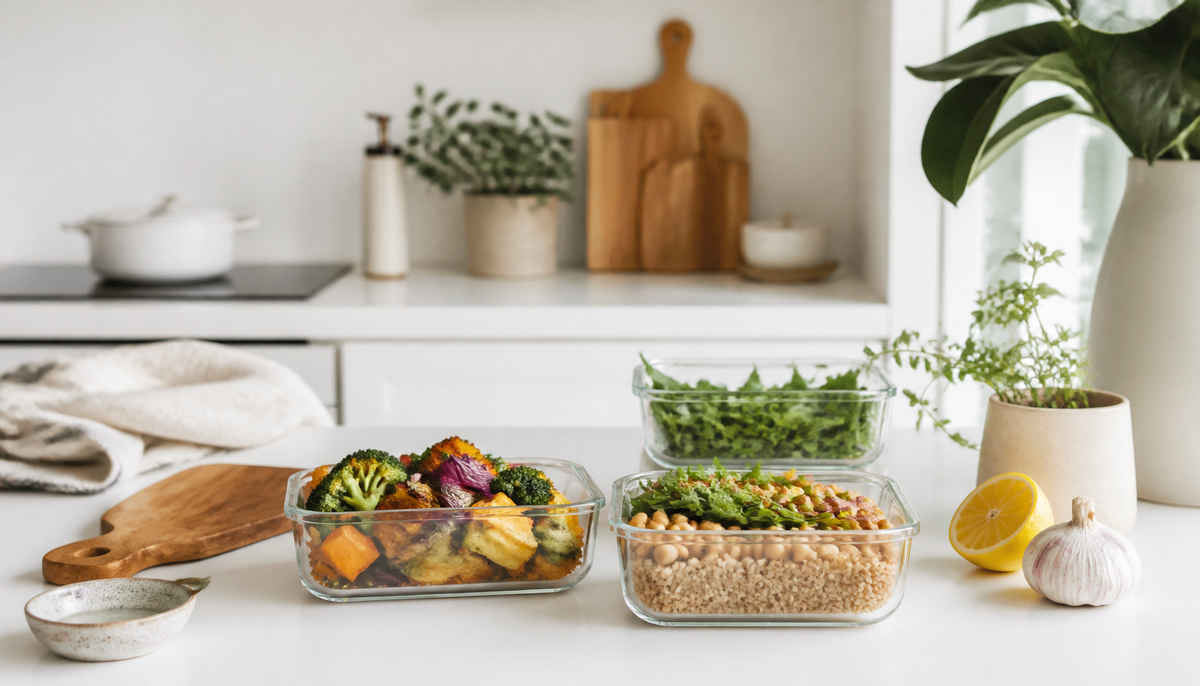
You don't hate meal prep. You hate the version you were sold.
The internet's version of meal prep looks like this: six hours on Sunday, twenty-one matching containers, a week of identical lunches, and a sink full of dishes by 7 p.m. It's a system designed for people who already love logistics. If that's not you, every failed attempt quietly teaches you that eating well requires a personality transplant.
It doesn't. The research on home cooking and diet quality points to something much less photogenic: frequency beats perfection. People who cook at home regularly — even simply, even the same three meals — consistently eat better than people who cook elaborately but rarely. That reframing matters, because it means the goal isn't a marathon Sunday session. The goal is the smallest repeatable version of meal prep that still moves the needle.
Key Takeaways
- Frequency beats perfection. How often you cook at home is consistently associated with better diet quality — even when the meals are simple.
- Minimum effective dose: one 30–45 minute session a week (or 10 minutes of nightly planning) captures most of the practical benefit for most people.
- Repeat menus remove decisions. A rotating set of 3–4 dinners works because it's boring — boredom is what makes it automatic.
- Habits take ~2 months to feel automatic. A 2024 meta-analysis found a median of 59–66 days, with wide individual variation. Small habits stick; grand systems don't.
- Supplements are a backstop, not a substitute. A foundational multivitamin can help cover gaps on the weeks cooking doesn't happen — it can't replace meals.
The Science: What Home Cooking Actually Buys You
The core evidence here is observational, so it's worth being precise about what it does and doesn't show. In a national sample of U.S. adults surveyed during the early months of the COVID-19 pandemic, Wolfson et al. (2022) found that cooking dinner at home more frequently was associated with better overall diet quality — and that food-insecure households, which cooked less, had the poorest diets. The direction of this finding echoes earlier work: more home cooking, better diet quality, even after accounting for income and education.
Meal planning specifically shows up too. In a Brazilian cohort, Gabe et al. (2023) examined the food practices recommended by national dietary guidelines — planning meals ahead, cooking at home, eating without distractions — and found that greater adherence to those practices was associated with meaningfully better diet quality scores. Planning, not just cooking, appears to be part of the mechanism: when the decision about dinner is made before 6 p.m., the 6 p.m. version of you eats better.
None of this tells you to batch-cook a week of food on Sunday. What it suggests is that the lever is regular, low-effort cooking and planning. And that's where habit research becomes useful. A 2024 systematic review and meta-analysis by Singh et al. pooled 20 studies on health-behavior habit formation and found that new habits took a median of 59–66 days to reach automaticity, with individual estimates ranging from 4 to 335 days. Two details from that review matter for meal prep: habits anchored to a consistent time or context formed more strongly, and smaller behaviors became automatic faster than complex ones. In other words, the science favors a modest ritual you'll actually repeat over an elaborate system you'll abandon in three weeks.
The Minimum Effective Dose System
Borrowing a concept from exercise science: the minimum effective dose is the smallest input that produces the desired adaptation. For meal prep, here's what that looks like in practice.
1. Fix a repeating menu
Pick 3–4 dinners you can cook on autopilot and like well enough to eat weekly. Two breakfast options maximum. This isn't a culinary limitation — it's decision hygiene. Every eliminated decision is energy you're not spending at 6 p.m. on an empty stomach. When you're bored in three weeks, swap one dinner; don't rebuild the list.
2. Shop from the menu, nothing else
Your grocery list is the ingredients for those dinners, plus produce and milk. That's it. Unbought snack food doesn't need willpower to avoid. This one habit — buying only what a fixed menu requires — quietly improves diet quality more than any kitchen skill.
3. One 30–45 minute block, once a week
Not four hours. Cook one grain, roast one tray of vegetables, and prep one protein. That's three components — enough to assemble dinners all week with different sauces and sides. Anything beyond this is a hobby, which is fine, but it's not a requirement.
4. Anchor it to something you already do
Attach the block to an existing fixture — Saturday morning coffee, Sunday after the gym. The habit literature is consistent here: context-dependent repetition is what turns effort into automaticity. Same time, same trigger, every week.
5. Maintain two emergency dinners
Keep ingredients for two meals you can make in ten minutes from pantry staples — eggs and frozen vegetables, canned beans and rice, that kind of thing. Emergency dinners are what keep one bad Tuesday from becoming a lost week. A habit that survives your worst days is the only kind worth building.
6. Give it two months before judging
Sixty-six days is a median, not a deadline — some people need far longer. Judge the system on how many weeks you ran any version of it, not on perfect execution. A week where you only managed the emergency dinner still counts.
Where Supplements Fit
The honest framing: supplements can't replicate what whole meals provide — fiber, food-matrix synergy, and the behavioral structure of actually cooking. But on the weeks when life wins and the menu collapses, a well-formulated daily multivitamin can help cover foundational micronutrient gaps so a bad stretch of eating doesn't become a bad stretch of nutrition too. For people who want that backstop without adding complexity, Evoria Health's Daily Essentials is formulated to cover core vitamins and minerals in a single daily serving — one fewer thing to plan on the weeks when planning fails.
Frequently Asked Questions
How long should meal prep actually take?
For the minimum effective dose approach: one 30–45 minute session per week, plus roughly 10 minutes of planning to build the grocery list. If a system requires more than that to maintain, most people will eventually stop maintaining it.
Do I have to prep every meal?
No. The research on diet quality emphasizes dinner — it's the meal most often eaten out or skipped, and the one where home cooking shows the clearest association with better diet quality. Nail dinners first; breakfasts and lunches can follow if you want.
How long until this feels automatic?
A 2024 meta-analysis found a median of 59–66 days for health habits to reach automaticity, with substantial variation between individuals. Two months is a reasonable expectation for the weekly ritual to feel like something you do rather than something you decide.
What if I get bored eating the same meals?
Vary the sauces, not the system. The same protein-and-vegetable base becomes three different dinners with salsa, peanut sauce, or lemon-garlic. Rotation at the component level keeps the decision count low without monotony.
Can a supplement replace meal prep?
No. Supplements cover micronutrient gaps; meals provide energy, protein, fiber, and the behavioral consistency that drives long-term diet quality. Think of a daily multivitamin as insurance for the off weeks, not as the plan itself.
Ready to put the science into practice?
Evoria's Daily Essentials covers your foundational vitamins and minerals in one daily serving — the nutritional backstop for the weeks cooking doesn't happen. Shop Daily Essentials →
References
- Wolfson JA, Posluszny H, Kronsteiner-Gicevic S, Willett W. Food Insecurity and Less Frequent Cooking Dinner at Home Are Associated with Lower Diet Quality in a National Sample of Low-Income Adults in the United States during the Initial Months of the Coronavirus Disease 2019 Pandemic. Journal of the Academy of Nutrition and Dietetics. 2022.
- Gabe KT, Costa CDS, Dos Santos FS, Souza TN, et al. Is the adherence to the food practices recommended by the dietary guidelines for the Brazilian population associated with diet quality? Appetite. 2023.
- Singh B, Murphy A, Maher C, Smith AE. Time to Form a Habit: A Systematic Review and Meta-Analysis of Health Behaviour Habit Formation and Its Determinants. Healthcare (Basel). 2024.
*These statements have not been evaluated by the FDA. This product is not intended to diagnose, treat, cure, or prevent any disease.
Share:
Creatine Beyond the Gym: Cognitive and Aging Research
Sulforaphane and Broccoli Sprouts: Nrf2 Activation and Human Evidence