




Few compounds have ridden the hype cycle as hard as sulforaphane. It has been called a "superfood molecule," credited with everything from cancer prevention to autism symptom relief, and marketed in everything from sprout powders to cold-brewed teas. Strip away the marketing, though, and what remains is genuinely interesting: a plant compound that doesn't act as an antioxidant in the conventional sense, but instead flips a genetic switch — Nrf2 — that tells your cells to build their own antioxidant and detoxification machinery.
That distinction matters. Most "antioxidant" supplements deliver molecules that directly quench free radicals, one molecule at a time. Sulforaphane works upstream, amplifying your cells' endogenous defense systems — enzymes like NQO1 and glutathione S-transferases that your body already uses to neutralize oxidative stress and process environmental toxins. The question is not whether this biology is real. It is. The question is how much of it translates into measurable outcomes in humans. Here, the honest answer is: promising, but preliminary.
🔑 Key Takeaways
- Sulforaphane is an isothiocyanate formed when cruciferous vegetables are chopped or chewed; 3–5-day-old broccoli sprouts are the most concentrated food source of its precursor, glucoraphanin
- Its primary mechanism is Nrf2 activation — upregulating your cells' own phase II detoxification and antioxidant enzymes rather than acting as a direct antioxidant
- Small human trials show biomarker changes (detoxification enzyme activity, oxidative stress) and preliminary signals in autism and schizophrenia symptom measures — but these trials are small and largely unreplicated
- Human research has typically used ~30–60 mg sulforaphane (or ~100–200 µmol glucoraphanin) daily, from sprouts or standardized extracts; bioavailability depends heavily on whether the myrosinase enzyme is active
- Short-term tolerability is good — GI effects are the most common complaint — but long-term outcome data in humans is lacking
What Is Sulforaphane?
Sulforaphane is an isothiocyanate — a sulfur-containing compound produced when cruciferous vegetables (broccoli, Brussels sprouts, kale, cabbage) are damaged: chopped, chewed, or blended. The plant stores sulforaphane in an inactive form called glucoraphanin. When plant cells rupture, an enzyme called myrosinase converts glucoraphanin into sulforaphane within minutes. This is the same chemistry that gives mustard and horseradish their bite — it's a chemical defense system the plant evolved against insects, repurposed by researchers as a molecular tool.
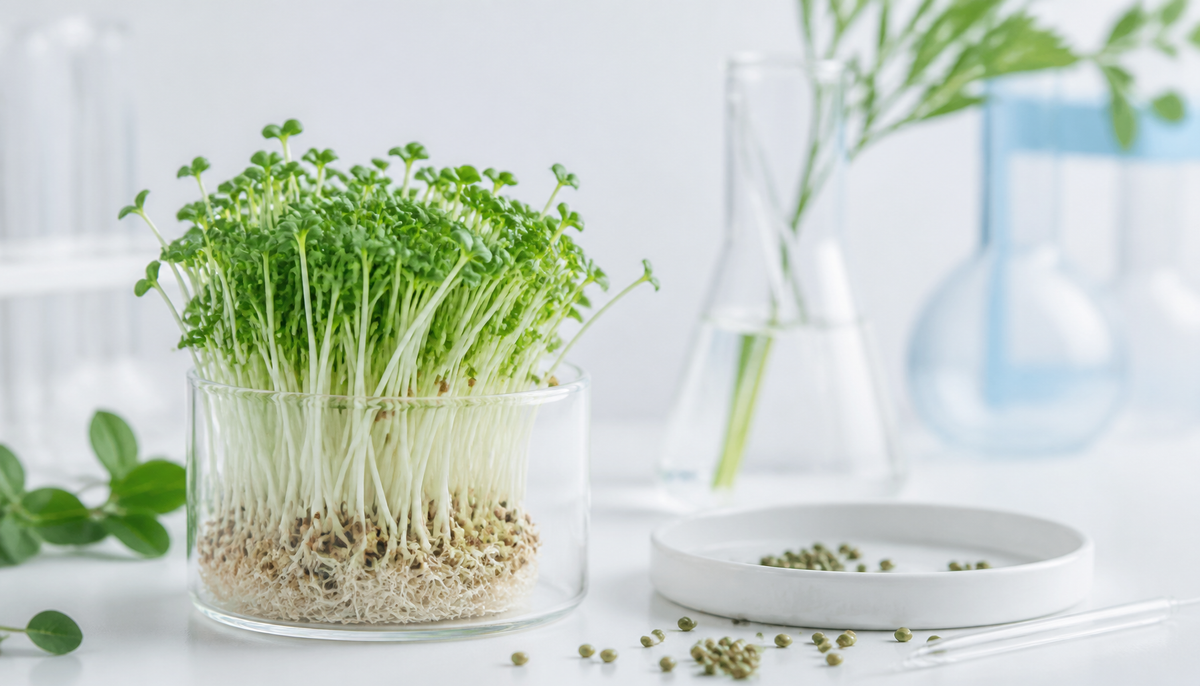
Not all sources deliver equal amounts. Mature broccoli heads contain modest levels of glucoraphanin, but 3–5-day-old broccoli sprouts are dramatically more concentrated — on the order of 20–100 times more glucoraphanin by fresh weight. This is why sprouts, not florets, became the standard research material: a few dozen grams of sprouts can deliver the glucosinolate doses used in clinical studies, which would otherwise require eating kilograms of mature broccoli.
One practical wrinkle: myrosinase is heat-sensitive. Boiling broccoli destroys the enzyme and leaches glucoraphanin into the water, substantially reducing sulforaphane yield. Without active myrosinase, conversion depends entirely on gut bacteria — a slower, more variable process that varies meaningfully between individuals. Formulation, in other words, is not a detail. It's arguably the single biggest determinant of how much sulforaphane a product actually delivers.
What the Research Shows
The Nrf2 Mechanism: Upstream of "Antioxidants"
The mechanistic case for sulforaphane rests on its interaction with the Nrf2 (nuclear factor erythroid 2-related factor 2) pathway. Under normal conditions, Nrf2 is held in check by a protein called Keap1, which flags it for degradation. Sulforaphane modifies Keap1's cysteine residues, releasing Nrf2 to travel to the nucleus and switch on a battery of cytoprotective genes — including NQO1, heme oxygenase-1, glutathione S-transferases, and enzymes involved in glutathione synthesis. A 2021 review in the British Journal of Pharmacology (Xu et al., 2021) details how this single upstream interaction explains sulforaphane's remarkably broad downstream effects on oxidative stress, inflammation, and xenobiotic metabolism in cell and animal models.
This mechanism is why sulforaphane is often described as one of the most potent naturally occurring Nrf2 activators known. But mechanism is not outcome. Cells in a dish upregulating NQO1 is a fact; whether that translation protects a human being from chronic disease over decades is a hypothesis — one that the human trial data has only begun to test.
Biomarkers in Humans: Real Changes, Unclear Significance
The best-established human findings come from trials measuring biomarker changes rather than clinical outcomes. A 2023 systematic review of sulforaphane's chemopreventive mechanisms (Janczar-Smuga et al., 2023) and a 2022 review of sulforaphane-enriched broccoli sprout interventions (Cvetanović et al., 2022) both summarize a consistent pattern: broccoli sprout beverages and extracts reliably increase phase II enzyme activity and modulate urinary oxidative stress markers in volunteers, at doses roughly corresponding to 30–60 mg sulforaphane or its precursor per day.
These are real physiological effects, measured repeatedly. What they are not is evidence of disease prevention. No long-term trial has demonstrated that sulforaphane supplementation reduces cancer incidence, cardiovascular events, or all-cause mortality in humans. The leap from biomarker to benefit is exactly where supplement marketing outruns the science.
The Autism Trial: Provocative, Preliminary
The most-cited clinical study remains a 2014 randomized controlled trial from Johns Hopkins (Singh et al., 2014). Forty-four young men with autism spectrum disorder received either sulforaphane (50–150 µmol daily, from broccoli sprout extract) or placebo for 18 weeks. Roughly half of the treatment group showed meaningful improvements on behavioral scales — the Aberrant Behavior Checklist improved about 34% on average among responders, with gains that faded after supplementation stopped.
It is an older study by our usual standards, and we cite it because no larger replication has since been completed. The trial was small, single-site, all-male, and unblinded to observable side effects. Subsequent smaller studies have produced mixed signals, and systematic reviews of sulforaphane in autism still classify the evidence as preliminary. Intriguing — yes. Practice-changing — not yet.
Cognition in Schizophrenia: An Open-Label Signal
A 2015 open-label study (Shiina et al., 2015) gave 30 mg/day of sulforaphane-rich broccoli sprout extract to ten patients with schizophrenia for eight weeks. Some cognitive domains appeared to improve; core psychiatric symptoms did not. With no control group and ten participants, this study can only generate hypotheses — but it helped motivate the ongoing research programs now testing sulforaphane as an adjunct in neuropsychiatric conditions, grounded in its documented effects on oxidative stress pathways in the brain.
Metabolic and Other Outcomes: Mostly Preclinical
For blood sugar regulation, liver health, and cardiovascular markers, the evidence base is dominated by cell and animal studies, with a small number of short human trials showing mixed results. The reviews cited above (Xu et al., 2021; Cvetanović et al., 2022) cover this literature honestly: consistent mechanistic plausibility, early-stage human data, and no confirmed long-term outcomes. Anyone claiming sulforaphane "reverses diabetes" or "prevents heart disease" is extrapolating well beyond what trials have shown.
Dosing & Practical Considerations
Human research has clustered around a few reference points:
- Standard trial doses: roughly 30–60 mg sulforaphane daily, or ~100–200 µmol of glucoraphanin, typically from broccoli sprout extracts or beverages
- Food equivalent: approximately 30–50 g of fresh broccoli sprouts per day delivers a comparable glucosinolate load
- Duration in trials: usually 1–18 weeks; long-term (multi-year) supplementation data does not exist
For practical purposes, three factors matter more than the headline number on a label:
- Myrosinase activity. Products standardized to glucoraphanin alone (especially heat-processed powders) depend on gut microbial conversion, which varies substantially between people. Extracts that preserve active myrosinase — or add it back via mustard seed, a rich source — deliver more predictable sulforaphane yields.
- Sprout handling. Fresh sprouts are effective but perishable and carry food-safety considerations (below). Chewing them thoroughly is, unglamorously, part of the mechanism.
- Cooking method. If using mature broccoli, light steaming (a few minutes) preserves glucoraphanin and some enzyme activity; prolonged boiling does neither.
Timing of intake — morning versus evening, fasted versus fed — has no meaningful evidence base. Consistency of daily intake has been the norm in trials, not scheduling.
Safety & Interactions
Across short-term trials, sulforaphane and broccoli sprout preparations have been generally well tolerated. The most commonly reported issues are gastrointestinal: bloating, gas, and loose stools, typically mild and dose-related.
Four caveats deserve more attention than they usually get:
- Raw sprouts and food safety. Sprouted seeds are a recognized vector for Salmonella and E. coli because warm, humid sprouting conditions favor bacterial growth. People who are pregnant, immunocompromised, elderly, or very young should generally avoid raw sprouts; cooking eliminates the risk but also reduces the enzyme activity that drives sulforaphane formation.
- Medication metabolism. Sulforaphane modulates phase I and phase II detoxification enzymes, which are also how many drugs are processed. The theoretical potential for interactions exists — it's the same machinery that makes the compound interesting. If you take prescription medications on a chronic basis, or especially if you're undergoing chemotherapy, discuss sulforaphane supplementation with your physician or oncologist before starting.
- Thyroid considerations. Cruciferous vegetables contain goitrogenic compounds at high intakes. At the supplemental doses studied, sulforaphane itself has not been shown to meaningfully affect thyroid function in healthy people, but individuals with existing thyroid conditions should be conservative and keep intake within studied ranges.
- Pregnancy and lactation. Data is limited. As with most concentrated botanical intakes during pregnancy, the prudent default is food-level cruciferous intake rather than high-dose extracts.
Bottom Line
Sulforaphane is one of the more biologically interesting compounds in the nutrition literature — a plant molecule that hijacks your cells' own stress-response circuitry (Nrf2) rather than acting as a simple antioxidant. The mechanistic evidence is strong, and small human trials show real biomarker effects plus preliminary signals in neuropsychiatric conditions. But the human outcome data — the part that would justify confident claims about disease prevention — simply doesn't exist yet. Regular consumption of cruciferous vegetables is well supported; concentrated extracts are a reasonable bet if you understand it is a bet, not a guarantee.
Frequently Asked Questions
How much sulforaphane is in broccoli sprouts?
Three-to-five-day-old broccoli sprouts contain roughly 20–100 times more glucoraphanin (sulforaphane's precursor) than mature broccoli by fresh weight. A typical research dose corresponds to about 30–50 g of fresh sprouts daily, though glucosinolate content varies by seed lot and growing conditions.
Are sulforaphane supplements equivalent to eating sprouts?
It depends on formulation. Extracts that retain active myrosinase (or include it via added mustard seed) convert glucoraphanin to sulforaphane efficiently. Heat-processed products that lack the enzyme rely on gut bacteria for conversion, which produces lower and more variable yields between individuals.
Does cooking destroy sulforaphane?
Prolonged boiling destroys myrosinase and leaches glucoraphanin into the cooking water, sharply reducing sulforaphane yield. Light steaming preserves most of the precursor and some enzyme activity. Raw sprouts maximize yield but carry foodborne illness risk for vulnerable groups.
What side effects are most common?
Mild gastrointestinal effects — bloating, gas, loose stools — are the most frequently reported issues in trials, generally dose-related and self-limiting. No serious adverse events have been attributed to the doses used in short-term human studies.
Who should be cautious with sulforaphane?
People undergoing chemotherapy, taking chronic prescription medications metabolized by liver enzymes, managing thyroid conditions, or who are pregnant, immunocompromised, or considering raw sprouts for young children should consult a clinician first — either because of theoretical enzyme interactions or raw-sprout food-safety risk.
Ready to put the science into practice?
Evoria's Total Longevity combines nine research-backed longevity ingredients — including NMN and Urolithin A — formulated to support cellular energy and antioxidant pathways as part of a daily healthy-aging routine. Shop Total Longevity →
References
- Xu Y, Saw CL, Zhang P, et al. Sulforaphane, a dietary isothiocyanate, in cancer prevention and therapy: From molecular mechanisms to clinical trials. Br J Pharmacol. 2021;178(19):3796-3811. PubMed
- Cvetanović A, Zengin G, Zeković Z, et al. Sulforaphane-Enriched Broccoli Sprouts as a Promising Dietary Intervention in Cancer and Chronic Diseases. Nutrients. 2022;14(16):3347. PubMed
- Janczar-Smuga M, Zawistowska M, Świtlicki Ł, et al. Mechanisms of Sulforaphane in Cancer Chemoprevention: A Systematic Review. Nutrients. 2023;15(16):3652. PubMed
- Singh K, Connors SL, Macklin EA, et al. Sulforaphane treatment of autism spectrum disorder (ASD). Proc Natl Acad Sci U S A. 2014;111(43):15550-15555. PubMed
- Shiina A, Shirayama Y, Niitsu T, et al. An Open Study of Sulforaphane-rich Broccoli Sprout Extract in Patients with Schizophrenia. Clin Psychopharmacol Neurosci. 2015;13(1):62-67. PubMed
These statements have not been evaluated by the FDA. This product is not intended to diagnose, treat, cure, or prevent any disease.
Share:
Meal Prep for People Who Hate Meal Prep: A Minimum Effective Dose Approach
How to Build a Wind-Down Routine That Actually Sticks